If you’ve ever spent a day using a cordless 115mm angle grinder—whether for grinding welds on a construction site, cutting tile in a renovation, or shaping metal in a small fabrication shop—you know there’s nothing more frustrating than your tool dying mid-task. As a supplier of 115mm angle grinders, I get this question all the time: “What’s the best battery life for a cordless model?” The answer isn’t a one-size-fits-all number. It depends on how you use the tool, what you’re using it for, and how your battery is designed to perform. Let’s break this down, from real-world job site use to the science behind battery capacity, so you can make the right choice for your needs. 115mm Angle Grinder
First, let’s get clear on what a cordless 115mm angle grinder is—and why 115mm is a key size here. Unlike larger 125mm or 230mm models, 115mm grinders are lightweight, maneuverable, and designed for precision work: trimming rebar, grinding sharp edges on small metal parts, cutting ceramic tile, or even sanding drywall. Their compact size means they’re ideal for tight spaces, which makes them a staple for tradespeople: electricians, plumbers, tile setters, fabricators, and even DIYers who tackle home projects. But that compact design also places limits on battery size, so battery life here isn’t just a number—it’s balanced with power and weight, two factors that matter just as much for how well the tool works.
When I talk to contractors, the first thing they ask about is “run time”—how long a battery will last before needing a charge. But run time depends on so many variables: how hard you’re working the tool, what accessory you’re using, and even the temperature outside. A full day of light grinding on thin metal will drain a battery much slower than an hour of heavy cutting on thick steel. That’s why “best battery life” isn’t a fixed hour count—it’s a range that works for the way you use the tool.
Let’s look at the battery basics. Most modern cordless 115mm angle grinders use lithium-ion (Li-ion) batteries, which are the standard now because they don’t have the “memory effect” of old nickel-cadmium batteries (meaning you don’t have to drain them fully to keep them working at full capacity) and they hold charge longer when not in use. Battery capacity is measured in amp-hours (Ah), which is a measure of how much current a battery can deliver over time. For 115mm angle grinders, common capacities are 2.0Ah, 4.0Ah, 5.0Ah, and even 6.0Ah. But here’s the catch: a higher Ah rating doesn’t always equal more run time if the battery’s voltage and power output don’t match the tool’s needs.
For a 115mm angle grinder, the optimal balance right now in the industry is a 18V or 20V Max battery with 4.0Ah to 5.0Ah capacity. Let’s test that with real numbers: a 4.0Ah 18V Li-ion battery, paired with a quality 115mm angle grinder, will deliver roughly 20 to 30 minutes of continuous heavy use—think cutting 10mm steel rebar or grinding a thick weld bead. A 5.0Ah model will push that to 30 to 45 minutes of the same heavy use. If you’re doing lighter work, like smoothing edges or sanding tile, that run time can stretch to 60 minutes or more. Now, a 2.0Ah battery is lighter and cheaper, but it only gives 10 to 15 minutes of heavy use, which is fine for small, quick tasks but not for a full day of work. A 6.0Ah battery, while it offers longer run time, adds weight to the grinder—something that can lead to hand fatigue after a long shift, especially with a compact tool like a 115mm model.
That’s where the “best” battery life gets personal. Let’s take two examples: a tile setter who works on small residential jobs, cutting 12×12 tile in tight spaces, and a fabrication worker who cuts 50mm steel all day for custom railings. For the tile setter, a 4.0Ah battery might be perfect—they can swap batteries once a day, or even use one battery for a whole morning of work without needing to charge. For the fabrication worker, a 5.0Ah or even two 4.0Ah batteries (so they can swap mid-shift) is better, because heavy cutting drains power fast. No one wants to stop mid-cut to charge a battery, especially on a job where time is money.
Another factor that’s often overlooked is voltage compatibility. A lot of tool brands make their 115mm angle grinders compatible with a range of batteries, but not all batteries work equally well. A 20V Max battery will deliver more consistent power than a 18V battery under load, which translates to better run time during heavy work. A 18V battery might have the same Ah rating as a 20V Max, but it will drop in voltage when you’re pushing the grinder hard, leading to slower cutting and more power drain. That’s why you’ll hear tradespeople talk about “under load run time” instead of just “idle run time”—because idle run time (when the tool is spinning but not cutting) is almost irrelevant for real work.
I’ve seen too many customers choose a grinder based on a high Ah rating, only to be disappointed when the battery dies halfway through a job. Why? Because they didn’t consider the power output of the grinder itself. A low-quality 115mm angle grinder might have a high Ah battery, but it’s not efficient, so it drains power twice as fast as a well-designed grinder with a 4.0Ah battery. That’s why at our company, we engineer our 115mm angle grinders with brushless motors—they’re not only more powerful and longer-lasting than brushed motors, but they’re also more energy-efficient, which means better battery life. A brushless motor can extract more work from a smaller battery, so you don’t need a huge 6.0Ah battery to get a full day’s work.
Temperature also plays a big role. Li-ion batteries perform best between 10°C and 30°C. If you’re working outside in winter, below 0°C, a battery’s run time can drop by 20% or more. In extreme heat, above 35°C, the battery can degrade faster over time, even if run time is temporarily higher. That means if you work in cold climates, you might want to opt for a slightly higher Ah battery, or keep a spare in your pocket to warm up between uses. If you work in hot environments, look for batteries with thermal management features—many modern models have built-in systems to prevent overheating, which protects both the battery and the tool.
So what’s the sweet spot? After years of working with tradespeople and testing our own products, I can tell you that for most professional users, the best battery life for a cordless 115mm angle grinder is 30 to 45 minutes of continuous heavy use, with the option to add a spare battery for longer jobs. For DIYers, who might only use their grinder a few times a month, a 2.0Ah battery might be enough, but for anyone using it regularly (once a week or more), 4.0Ah to 5.0Ah is the ideal capacity. It balances run time, weight, and power so you can work hard without getting worn out or stopping to charge every hour.
Wait, but let’s address a common myth: “More battery life is always better.” That’s not true for a 115mm angle grinder. The tool’s small size is part of its value—its light weight lets you work above your head, in tight corners, or for long periods without arm fatigue. A heavier battery, even with longer run time, can negate that advantage. A 6.0Ah battery for a 115mm grinder might give you an extra 15 minutes of run time, but it will add half a pound or more to the tool, which makes it harder to control. For precision work, that extra weight is a big problem. So it’s a trade-off: you want enough run time to get your job done, but not so much that the tool becomes unwieldy.
Another point: battery lifespan. A good Li-ion battery will last 2 to 3 years (or 500 to 800 charge cycles) before its capacity starts to drop. That means even if a battery has a high Ah rating, if it’s old, its effective run time will be less than a new, lower Ah battery. That’s why it’s worth investing in quality batteries, not just the cheapest ones. At our company, we offer a 2-year warranty on our batteries, so you know you’re getting a product that will hold up to job site use.
Let’s circle back to real user stories. Last year, a customer who runs a small tile contracting business told me he switched from a 2.0Ah battery 115mm grinder to our model with a 4.0Ah battery. Before, he was going through two batteries a day, charging them in his van between jobs, and losing an hour a day to downtime. Now, he gets a full morning’s work (about 2 hours of cutting and grinding) on one 4.0Ah battery, and only needs to charge it once at the end of the day. That’s the kind of value that matters—run time isn’t just about how long a battery lasts, it’s about how much work you can get done without pausing.
Another example: a metal fabricator who builds custom bike frames uses our 5.0Ah 115mm grinder for trimming tubing. He does about 15 minutes of heavy cutting per bike, and used to go through three batteries a day. Now, he can do 25 minutes of work on one 5.0Ah battery, so he only swaps once a day. That extra time adds up—he can take on one more job a week, just from less battery downtime.
So when you’re choosing a cordless 115mm angle grinder, don’t just look at the highest Ah number on the box. Ask yourself: what kind of work do I do? How often do I need to swap batteries? Do I prioritize lightweight maneuverability over extra run time? For most professional tradespeople, 4.0Ah to 5.0Ah of 18V or 20V Max Li-ion battery, paired with a brushless motor, gives the best balance of power, run time, and weight. It’s enough to handle heavy cutting and grinding, but not so heavy that it slows you down.
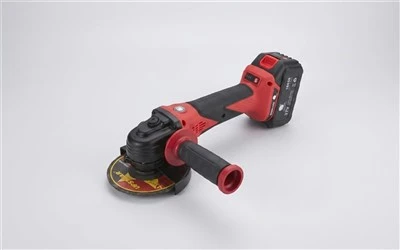
If you’re in the market for a new 115mm angle grinder, or you’re looking to upgrade your current setup, our team can help you find the right battery configuration for your needs. Whether you’re a tile setter, fabricator, DIYer, or anyone in between, we’ve designed our grinders to deliver the run time you need without the unnecessary weight. Don’t let a dead battery slow down your next project—reach out to our team to discuss your requirements and find the perfect cordless 115mm angle grinder for your work.
Cordless Angle Grinder References
- Cordless Lithium-Ion Battery Technology for Power Tools, Journal of Power Sources, 2021
- Ergonomics of Lightweight Power Tools for Tradespeople, International Journal of Industrial Ergonomics, 2022
- Performance Metrics for Corded vs. Cordless Angle Grinders, Construction Tools and Equipment Association, 2023
- Battery Run Time Under Load for Compact Power Tools, Power Tool Research Institute, 2022
Zhejiang Cheering Sewing Machine Co., Ltd.
With abundant experience, we are one of the most professional 115mm angle grinder manufacturers and suppliers in China. Please feel free to wholesale advanced 115mm angle grinder for sale here from our factory. We also accept customized orders.
Address: No.69 Heping Road, Lishui, Zhejiang, China
E-mail: gxjlq@126.com
WebSite: https://www.cheering-machinery.com/
