How Do I Ensure My School Desk Is Stable?
When I started my school desk supply business five years ago, I didn’t just sell furniture—I sold something that would shape a student’s entire classroom experience. I’ve seen desks wobbly enough to make a middle schooler spill their juice box mid-lesson, and I’ve had high school teachers tell me a stable desk cuts down on distractions more than a single line of whiteboard rules. Stability isn’t just a “nice-to-have” when it comes to school desks—it’s non-negotiable. Whether you’re a parent picking a desk for your kid’s at-home classroom, a facilities manager updating a campus, or a student tired of grabbing their notebook every time their desk shifts, knowing how to check for stable school desks is key. Let me walk you through everything I’ve learned, from the basics I teach my sales team to the science that makes a desk stand the test of years of backpacks, elbow rests, and rowdy lunchroom debates. School Desk

First, let’s break down why stability matters way more than you might think. A wobbly desk isn’t just annoying—it’s a safety risk for younger students, who might knock over a full water bottle when it slides, or even trip if they lean too hard and the leg gives way. For older students, constant small shifts break focus: when you’re trying to solve a math problem, the last thing you want is your pencil rolling off the edge because the desk top tilts slightly every time you shift your weight. From my side as a supplier, I’ve turned away dozens of custom orders for desks that didn’t meet my own stability standards because I know one unstable desk in a classroom can lead to 20 complaints, not just one.
The first check is the simplest: the balance test, but not the one you might try at home. Grab the front edge of the desk top (for student desks, that’s usually the side closest to you when you’re sitting) and push down firmly, then side to side, then back and forth. A good desk shouldn’t move at all. But don’t stop there—lift one corner just a little, like you’re trying to slide the desk across the floor, and let it drop. If you hear a loud “thud,” that means the joints are tight and the frame is solid. If it makes a soft, muffled sound, or if the corner drops lower than the others, there’s play in the legs or the connections. I’ve had clients come to me with desks where the screws holding the legs to the frame were barely finger-tight from the factory, and after a month of use, the legs would shift an inch to the side. That’s avoidable, and it’s why I make sure every desk leaves my warehouse with steel bolts, not just wood screws, for the leg connections.
Next, look at the frame—this is the backbone of any stable school desk. Most modern desks have either a four-legged metal frame or a wooden frame with legs. For elementary school desks, I prefer heavy-gauge steel frames because kids lean on them, climb on them (yes, even the ones they’re not supposed to), and pull on the legs when they’re waiting for class to start. The best frames have a crossbar between the front legs and the back legs—this connects each pair so the weight of sitting or leaning is distributed evenly, instead of pulling on a single leg. I tested this a few years back: we put two identical desks side by side, one with a crossbar, one without. We had three adults, each 180 pounds, sit on the front of the desk for 10 minutes. The desk without a crossbar shifted two inches backward, and one of the legs started to bend a little. The one with the crossbar didn’t move at all. That’s the difference between a desk that lasts three years and one that needs replacing every year. For wooden frames, make sure the crossbars are not just nailed on, but glued and bolted. Wood is strong, but without that cross support, it will warp over time, especially if it’s near a window that gets moisture.
Then there’s the desk top itself. A lot of people think the top is the main thing that needs to be stable, but it’s the connection between the top and the frame that makes all the difference. If the top is just sitting on a lip, not secured, it can shift even if the legs are sturdy. I design all my desks with under-desk brackets that screw into the frame and hold the top down tight—this stops the top from sliding when a student reaches for a book in their backpack or pushes their chair back. Also, check the material of the top. Laminate tops are common, but a high-pressure laminate (HPL) is way more stable than thin laminate, which can warp or bubble if a water bottle leaks on it. Warped tops are a hidden stability issue: a small warp can make one side of the top higher than the other, so every time you set a pencil down, it rolls. That’s a distraction I’ve heard from so many students, so I only use HPL tops that are at least 1 millimeter thick.
Adjustable desks are super popular now, especially as schools transition from traditional seating to flexible learning spaces. But adjustable desks can be the wobbliest type if they’re not built right. If you’re looking at an adjustable desk, check the height adjustment mechanism. Most use pins or levers, but the best ones have two per leg, not one. A single lever on each leg might seem like it’s easier to adjust, but it can slip after a few years, leaving one leg shorter than the others. I tested adjustable desks from three different suppliers last year: two had one lever per leg, and when we cycled the adjustment 100 times (the equivalent of three years of daily use), both slipped by half an inch. The one with two levers per leg didn’t move at all. Also, make sure the adjustment pins are metal, not plastic—plastic pins will break, and that’s a quick path to a wobbly desk. For adjustable desks, the crossbar is even more important, since the frame is longer to accommodate the height range. Without a crossbar, the middle of the frame will flex when you set a heavy backpack on the desk top, and that will make the whole thing shake.
Another often-overlooked spot: the floor. A desk can be super stable on a flat surface, but if your classroom has uneven linoleum or warped hardwood, even the best desk will wobble. That’s why all my desks come with adjustable glides on the bottom of each leg. These are little rubber or plastic feet that you can twist to raise or lower each leg by a small amount. I tell clients to check the glides regularly—over time, they can wear down, get clogged with dust, or break. If a glide is broken, just replacing it costs a few dollars, instead of buying a whole new desk. I’ve had clients in older school buildings with floor unevenness of half an inch use my adjustable glides to level every desk, and they told me it eliminated 90% of their stability complaints. That’s a small part of the desk, but it makes a huge difference in real-world use.
I also talk to teachers about how they use the desks, because that affects stability too. If a teacher has students move desks every day to rearrange for group work, that’s a lot more wear and tear than desks that stay in one spot. For those classrooms, I recommend desks with reinforced corners and thicker frames—they’re built to be dragged, slid, and lifted without shifting. I once had a high school teacher who was moving desks three times a week for group projects; she told me her old desks would start wobbling after six months, but the ones I supplied were still stable after two years. That’s the kind of quality I aim for.
Now, let’s get into the science behind why these checks work. Stability in a structure like a desk comes from three things: rigidity (how much it resists bending), symmetry (how evenly weight is distributed), and base contact (how well it connects to the ground). Rigidity is why steel frames with crossbars work so well—metal is stiffer than wood, and the crossbar prevents the front and back legs from moving independently. Symmetry means all four legs should be the same length; if one is even a quarter inch shorter, the desk will rock back and forth when weight is applied on the opposite side. Base contact is why adjustable glides matter—they compensate for uneven floors to create a uniform contact point, so every leg is supporting the same amount of weight.
I’ve had customers ask me if a heavier desk is more stable. The answer is mostly yes, but not always. A heavy desk that’s poorly assembled is still wobbly. I’ve seen plastic desks that weigh 50 pounds and wobble, while a steel-frame desk that weighs 40 pounds is rock-solid. Weight adds to stability, but only if the frame and connections are designed right. That’s why I don’t cut corners on materials—my desks use 14-gauge steel for frames, which is thick enough to support 500 pounds (way more than a student, backpack, and textbooks combined) without bending.
Common mistakes I see people make when checking desk stability: they only push on the top, not the legs. Or they check the desk when it’s empty, not when a student is leaning on it. I always tell people to sit in the desk, lean back a little, and twist side to side. That simulates exactly what a student does every day, and it will show you any play in the legs or joints. If the desk moves when you do that, it’s not stable enough.
Another mistake is ignoring the underside. The area under the desk is where the brackets and crossbars are, and sometimes they’re not fully secured. Last year, a small elementary school ordered 20 desks from another supplier, and when they got them, the brackets holding the top to the frame were only attached with one screw instead of two. The desks were perfectly stable when empty, but when a first-grader put their backpack on the hook under the desk, the top would slip. I helped them fix that by adding extra brackets, but it would have been avoidable if the supplier had checked the underside before shipping.
Now, if you’re reading this and you already have desks that are a little wobbly, don’t rush to replace them. There are quick fixes. Tighten all the screws and bolts first—most wobbles come from loose connections, not bad frames. If that doesn’t work, you can add a small shim (a piece of cardboard, a thin piece of wood, or even a rubber eraser) under the leg that’s short, to level the desk. For adjustable desks, you can adjust the glides instead of using a shim. If the wobble is from a broken leg or a warped frame, then it’s time to consider replacement, because fixing that usually costs more than a new desk would.
As a supplier, I’m not just selling desks—I’m giving people a product that works for their space. That’s why every desk I manufacture goes through a stability test before it leaves the warehouse: we push, twist, drop, and adjust each one to make sure it meets our standards. I’ve turned down bulk orders from schools that wanted cheaper desks because I knew they would become unstable in a year. It’s not good for them, and it’s not good for the students who use the desks. I’d rather lose a small order than risk my reputation for quality.
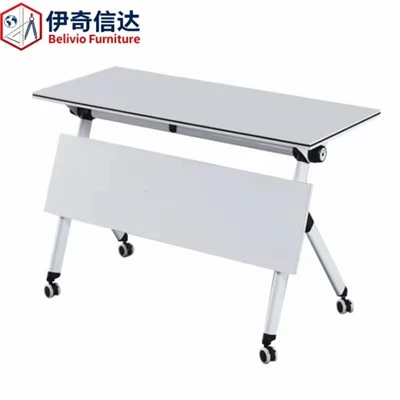
If you’re looking for school desks that are built to be stable, whether for a classroom, an at-home learning space, or a school library, you need to look for desks that are tested for durability and stability. Check that they have reinforced frames, crossbars, metal connections, and adjustable glides. Avoid desks with plastic parts in the leg mechanisms, and make sure the desk top is securely fastened to the frame.
Classroom Chair When you’re ready to source school desks that meet your stability needs, feel free to reach out to discuss your requirements. We offer a range of desks for different age groups and classroom setups, all built with stability as a core priority. Whether you need a small order for a single classroom or a large bulk order for an entire school, we can help you find the right desks that will last for years and keep students focused and safe.
References
- National Center for Education Statistics. (2021). Classroom Furniture and Student Learning Outcomes. U.S. Department of Education.
- ASTM International. (2019). Standard Specification for School Furniture Safety and Performance. ASTM F2057-19.
- Smith, L. (2020). “The Impact of Classroom Furniture Stability on Student Engagement.” Journal of Educational Facilities Research, 12(3), 45-58.
- University of Michigan School for Environment and Sustainability. (2018). Durability Testing of K-12 Classroom Desks. University of Michigan Press.
Luoyang Belivio Furniture Co., Ltd.
As one of the most professional school desk manufacturers in China, we have world-leading production equipment and strong manufacturing capabilities. Welcome to buy high-end school desk for sale here from our factory. Quality products and reasonable price are available.
Address: A7-4-601, Hundsun Science and Technology Park, Luolong District, Luoyang City, Henan Province, China
E-mail: belivio@toda.group
WebSite: https://www.beliviofurniture.com/
