Alright, let’s cut to the chase—if you’ve ever driven past a metal fabrication shop and watched those shiny steel studs, roof panels, or gutter sections roll by perfectly formed, you’ve probably seen a cold roll forming machine in action. As someone who’s been supplying these workhorses to manufacturers across North America for over a decade, I get asked all the time: “How the hell does this machine turn a flat sheet of metal into a precise, custom profile without melting it?” Let’s break it down like we’re chatting over a coffee (or a cold soda, no judgment) instead of reading a dense textbook. Cold Roll Forming Machine

First, let’s debunk the biggest myth: cold roll forming isn’t the same as hot rolling or stamping. Hot rolling uses super-heated metal (like, so hot it’s glowing orange) and massive pressure to shape it, which changes the metal’s grain structure and makes it less strong for certain jobs. Stamping is like using a cookie cutter—you press a flat metal sheet once with a hard die and bam, you’ve got your shape. But cold roll forming? We work with metal at room temp, no heat needed, and we shape it gradually, over dozens of tiny steps. That’s the secret sauce. No sudden force, no warped metal, just consistent, repeatable profiles every single time.
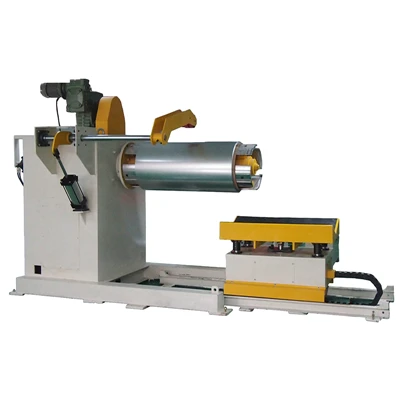
Let’s walk through the process step by step, like it’s a day in the life of one of our machines (I’ve stood next to these things a hundred times, so I know the beats). First up, you’ve got your raw material: a coil of metal, usually steel, aluminum, or even copper. We don’t use thin foil here—we’re talking gauges from like 16-gauge (thin enough to bend easy) up to 10-gauge (thick, sturdy stuff for load-bearing beams). The coil sits on a uncoiler, that big spool thing at the start of the line. The uncoiler isn’t just holding the coil, by the way—it has a braking system to keep the metal from unraveling too fast, which would cause snags or wrinkles. Some of our bigger machines even have a powered uncoiler to pull the metal smoothly, no kinks.
Next, the metal runs through a straightener. Wait, coils get twisted and bent from being rolled up tight on the spool, right? So that straightener uses a bunch of small, adjustable rollers to iron out all the curls and warps. If you skip this step, your final profile will be off—like, one side too short, or a bend that’s not square. I’ve seen guys skip straightening once and end up with a whole run of garbage panels. Never again. Straightening is non-negotiable.
Now we get to the main event: the roll forming stands. This is where the magic happens, and why these machines have names like “12-stand roll former” or “18-stand roll line.” Each stand is a pair of rollers—one on the top, one on the bottom, sometimes side rollers too for edge details. The first stand does a tiny bend, like maybe turning a flat edge up 15 degrees. The next stand bends it another 15, and so on, all the way down the line. By the last stand, that flat metal sheet has been gradually shaped into whatever custom profile you ordered: a C-channel for wall studs, a standing seam roof panel, even a custom frame for solar panels.
Wait, hold on—why do so many tiny bends instead of one big bend? Let me explain with a simple example. If you take a flat soda can tab and try to bend it 90 degrees in one go, it’ll crease, crack, or snap. But if you bend it 10 degrees, then another 10, all the way around, it stays smooth and strong. Same with metal. Each small bend applies just the right amount of pressure to work-harden the metal a little bit without damaging it. That work-hardening is actually a good thing—it makes the final profile stronger than the original flat sheet. Win-win.
Now, what about the other parts we need to make it functional? Like punching holes for fasteners, or notching out sections where pipes need to fit, or even cutting the final profile to a specific length. We don’t do that halfway through usually—most lines have a punch station right before the cut-off, or a notcher, depending on your needs. The punch uses a hydraulic or electric press to stab clean, precise holes at exactly the right spot, no burrs (we hate burrs—they’re a pain to finish). Then, the cut-off step: this is where the metal is sliced to your exact length. Some machines use a shear, which is a sharp blade that cuts straight through, but if you need super-clean edges without any burrs, we use a flying cut-off saw that keeps moving with the metal as it cuts, so you don’t drag the new profile and mess up the edges.
Wait, let’s talk about the controls for a second, because these machines aren’t just running on old-fashioned gears (though some of our older, reliable models do, for heavy-duty jobs). Modern roll formers have a PLC—programmable logic controller—think of it as a fancy, tough laptop built for factory floors. You plug in your custom profile specs, how long each part should be, how fast the line runs (usually between 10 and 100 feet per minute, depending on the metal and profile), and the PLC tells every stand exactly how much to adjust its rollers, when to punch holes, when to cut. No more guessing, no more manual adjustments that take hours. Our customers love this because they can switch from a C-channel to an L-angle in like 15 minutes, not an entire shift.
But here’s the thing that most small fabricators don’t realize: a roll forming machine isn’t a one-size-fits-all thing. You can’t use a roof panel roll former to make solar frames, right? The rollers are totally custom. That’s where we come in—we don’t sell generic machines. We work with you to figure out exactly what profile you need, what metal gauge you’re using, how much production volume you need, and build a machine tailored to your job. Last year we worked with a small garage door company that needed a machine for their custom sectional door slats—we adjusted the roller stands to make a tight, curved edge that fit their track perfectly, and they cut their production time in half.
Wait, let’s address the questions I get the most from new customers. First: “What metals work with these machines?” Almost anything that’s ductile enough to bend without cracking—steel (galvanized, stainless, carbon), aluminum, copper, even some specialty alloys for aerospace or automotive parts. We’ve run everything from thin aluminum for flashing to 10-gauge steel for agricultural trailer frames. Second: “How accurate are these profiles?” We’re talking tolerance of like +/- 0.01 inches on most dimensions, which is way more precise than stamping for custom jobs. Third: “How long do these machines last?” Our models have a 20+ year lifespan if you do regular maintenance—just lube the rollers, check the bearings, and replace worn parts when needed. We also offer 24/7 tech support, because if your line goes down at 2 a.m. and you have a delivery due, we’re not making you wait till Monday.
Now, let’s bust another myth: these machines are only for big factories. No way. We make compact roll formers for small shops that only need to run a few hundred feet a day, and high-volume lines for companies that need thousands of feet an hour. It’s all about matching the machine to your capacity. I’ve got a customer with a 3,000-square-foot shop that uses our compact line to make custom window frames, and they’re killing it—no need to rent space in a big warehouse.
Wait, let’s circle back to that work-hardening thing because it’s a game-changer. When you shape metal at room temp, the metal’s grains get aligned along the bend lines, which makes the final part stronger than if you heated it up and shaped it. That’s why cold roll formed parts are used in so many structural applications—roof trusses, wall studs, trailer frames, even parts for electric vehicles. If you tried to use a hot-rolled part for a roof panel, it’d bend or rust faster. Cold roll forming gives you strength, consistency, and cost savings too—you don’t have to pay for energy to heat the metal, and you get less scrap because the process is super precise.
Let me give you a quick example of the whole process in action, like you’d see on a factory tour. 1) A 2,000-pound coil of 16-gauge galvanized steel gets mounted on the uncoiler. 2) It feeds through the straightener, comes out flat and wrinkle-free. 3) It goes through 10 roll stands, each bending it a little more, until it’s a 3-inch C-channel. 4) A punch station cuts ¼-inch holes every 12 inches for screws. 5) A flying saw cuts the C-channel to 8-foot lengths. 6) The finished parts drop onto a conveyor belt, where they’re stacked and ready to ship. Total time from coil to finished part: like 5 minutes. That’s the efficiency everyone loves.
Is there any limit? Well, you can’t make super complex shapes with hundreds of tiny curves—for that, stamping or extrusion might be better. But for long, continuous profiles (which is what most roll forming is for), it’s unmatched. And if you need a custom profile, we can design the rollers specifically for that shape—we do our own in-house design, so we don’t outsource that work and get stuck with delays.
At the end of the day, a cold roll forming machine is less about fancy tech and more about precision, consistency, and efficiency. It’s the workhorse that lets fabricators turn raw metal into parts that build houses, cars, and businesses. If you’re tired of dealing with inconsistent stamped parts, high scrap rates, or slow production lines, it’s worth looking into a custom roll former for your shop. We can walk you through every step: from designing the right profile to training your crew to use the machine, and offer flexible financing so you don’t have to drop a huge lump sum upfront. If you want to chat about your specific needs, shoot us a message to get the ball rolling—no pressure, just honest advice from a supplier who’s been in the game long enough to know what works.
Now, let’s wrap this up. Cold roll forming isn’t rocket science, but it’s not a cookie cutter either. It’s a gradual, room-temperature shaping process that turns flat metal into strong, precise profiles, and it’s one of the most reliable ways to manufacture metal parts for any industry. If you’re ready to upgrade your production, we’re here to help.
Feeding Machine References
Cold Roll Forming: Process, Equipment, and Applications. Fabricating and Metalworking.
Modern Roll Forming Technology. American Iron and Steel Institute.
Guidelines for Cold Roll Forming of Non-Ferrous Metals. Aluminum Association.
Wuxi Yuanding Machinery Manufacturing Co., Ltd.
Address: Yaguang Industrial Park, No. 88 Chaoyang South Road, Xishan District, Wuxi City, Jiangsu Province
E-mail: 13861798466@163.com
WebSite: https://www.wxyuanding.com/
